Oh Christmas Tree, Oh Christmas Tree
My Christmas tree is listing like a drunken sailor. I wonder why. Perhaps because I got it lit on cheap vodka.
Which some might judge as tree abuse. But in my defense, I always welcome Yuletide conifers into my home with a big cup of boozy cheer. It is my long-held tradition, and no prior tree has ever shown the slightest sign of inebriation.
So how was I to know this year’s tree would be the first of its grand, evergreen kind unable to hold its liquor! Each one of its numerous predecessors received the same generous pour of holiday spirits and yet managed to stand upright with their dignity intact. Rather than leaning rearwards like some off-balance lush. Fairy lights weaving through shaky branches. Baubles dangling precariously. Crowning star sitting cockeyed and pushed back.
Rest assured, it has never been my objective to overserve Christmas trees. My intentions have been pure. I have merely wanted to keep my firs, pines, and spruces vibrant and their deaths postponed for as long as possible, and consuming a copious amount of vodka helps. It helps a lot. At least that has been my observation for lo these many years.
However, I could be wrong. Certainly, the experts at the National Christmas Tree Association disagree with me. They contend there is no truth to the notion that vodka breaks up resin, the thick, gooey substance secreted as a protective response to injury by virtually all conifers, as well as quite a few deciduous trees and other plants too.
It goes without saying that a Christmas tree that has been chopped down and had its trunk severed from its roots has suffered an injury. Its cut will then ooze resin which will form a sealant. As good as a wound adhesive as resin is, shielding the tree from pathogens and insects, its gumminess also prohibits the water the tree needs from being absorbed through its rootless trunk. This is why it is recommended by real Christmas tree enthusiasts everywhere that, before putting the tree in its stand, a new cut be made by sawing an inch or so off its bottom.
Afterwards, the sooner the tree is stood in water, the better. Though this will not prevent it from secreting more resin. Excessive buildup can still occur. But a guzzle of vodka can foil a killer clog. Or not.
The National Christmas Tree Association additionally maintains that alcohol, or for that matter, any additive, dehydrates a tree, causing needles to become brittle and shed faster. They, along with multiple plant physiologists at universities and other places of prestige recommend a Christmas tree have its thirst consistently quenched with plenty of plain, cold, fresh water and only plain, cold, fresh water.
Nonetheless, it is my tradition to treat my Christmas trees to a welcoming vodka cocktail, and before now, my intemperate hospitality has always seemed to work to their benefit. Still, perhaps my current tree is trying to tell me otherwise, and I have been putting my faith in an old wives’ tale.
Albeit, the practice of presumably invigorating a Christmas tree with vodka began, not with old women, but with a middle-aged man. In 1989, Kenneth Takeo Nagao, a long-time resident of Eugene, Oregon and proud American of Japanese-Hawaiian heritage, started what would become a popular Christmas tradition. As a successful and influential architect who designed many private homes and public buildings, Mr. Nagao must have been familiar with lacquer, a common finishing material originally made of tree resin and one that holds a prominent place in the history of architectural and interior design.
Although I have no idea if Mr. Nagao had any knowledge of such, it is perhaps also relevant that lacquer work is an ancient Asian art form, its beginnings dating back to around 5,000 BCE. It is an extremely labor-intensive craft that creates a highly durable and glossy surface on all sorts of items, including furniture, screens, everyday utensils, musical instruments, decorative art, and even coffins. Intricate designs are achieved through layering anywhere from dozens to over one hundred coats of lacquer, with various layers sometimes applied in different colors and inlaid with such delicate materials as eggshell, mother-of-pearl, gold filament, silver leaf, etc. Complex carvings and fine paintings, frequently featuring mythological or nature scenes are also customary. Just as remarkably, despite being as old as civilization, lacquer work was paramount to the Modern Movement of the late 19th to mid-20th centuries when the fearless, ground-and-glass-ceiling-breaking Irish architect and furniture designer, Eileen Gray, put it to contemporary use in her famous designs.
Whether Mr. Nagao knew about Asian lacquer work or not, it makes sense, because of his professional experience, he would theorize as he did. Since traditional lacquer is made of resin from Asian sumac trees, and both methanol and isopropyl alcohols liquify lacquer, it stands to reason Mr. Nagao would suppose the ethanol found in all alcoholic beverages would similarly dissolve the resin secreted by a wounded Christmas tree. But plenty of scientists disagree with him, and I strongly believe in science.
There was one scientist of plant physiology, a college professor I found in my research, who admitted that, though skeptical, he was keeping an open mind because “biology is a complex and wonderful business.” While I am no biologist, I am certainly a huge fan of life, and whether biological or otherwise, its processes provide me with endless fascination. Consequently, I could not agree more with the open-minded professor.
Also hopefully worth considering on Mr. Nagao and my behalf is that old wives’ tales, like all folktales, often do contain a seed of truth. Like any seed, if rightly sown and given favorable growing conditions, a folktale seed can emerge and arise from where it was planted as something more. Something maybe even grand and evergreen.
After all, whether they be mythmakers dealing with lofty mysteries, like the origins of the universe, or old wives grappling with minor problems, like combating the common cold, folktale creators are not as different from scientists as one might think. Both are truth seekers and discoverers. Whereas scientists rely on empirical evidence and repeated testing, folktale inventors rely on poetic license and the subconscious.
Through artistic expression, folktales plant their seeds of truth and usually in a way that requires the receiver to do at least some, and sometimes a lot of intellectual exploring and interpretation on their own. Unlike the direct truths of science, a folktale truth tends to be veiled, like a bride with her face draped in tulle and lace. Who lifts that veil depends upon the giving of favorable growing conditions (the diligent and difficult work of love and commitment).
Despite this year’s Christmas tree embarrassing me by appearing sloshed and unable to stand up straight, I am not tempted to go for an artificial tree. At least not yet, but maybe someday. Because sometimes I do wonder if I am right to remove from its natural home and cut short the life of an innocent young tree just so I can brighten and freshen my dark, stuffy winter home with its warm, comforting light and clean, crisp scent so reminiscent of outdoor air. How in return for the balm it bestows, I dress its solemn, displaced, dying self in a gaudy December fashion, and then come January, strip naked its once-supple branches gone stiff with premature aging (or perhaps too much vodka), and toss the poor thing out into the cold to meet its untimely end alone and forgotten.
Then there are the environmental concerns and the question of which Christmas trees are more ecologically harmful, real or artificial. I have tried to do conclusive research on this topic, but it turns out the issue is exceedingly complex and dependent upon multiple factors.
As they grow, real Christmas trees consume significant amounts of water. They are often fed fertilizers and treated with pesticides and herbicides. None of which is good for the environment and us.
On the other hand, real Christmas trees support forestry and a continuous cycle of growth that captures carbon. On a Christmas tree farm, trees are typically grown for roughly ten years. As a result, for every tree cut down in a year, nine are left standing to soak up carbon, prevent erosion, provide a haven for nesting birds and a likely foraging site for wildlife.
Real Christmas trees also preserve the rural landscape. What’s more, there are purportedly people who have more direct contact with their real Christmas tree than any other forest product. That is hard for a nature lover like me to believe. Yet, I must admit it has been my own observation that too many people scarcely ever interact with the natural world. If real Christmas trees can help show them what they are missing and get them to care just a little bit more for the planet, I say, sorry for your sacrifice real Christmas trees, but your loss is Mother Earth and all life’s gain.
As for artificial trees, they do have the potential to be more environmentally friendly than their real counterparts, but only if they are reused for at least ten to twelve years and sometimes much longer. This is because artificial Christmas trees are normally made largely from plastic. The plastic is produced from the carbon-rich fossil fuel of petroleum during an industrial process that generates large amounts of carbon dioxide (CO2). More industrial emissions occur when the tree itself is manufactured. Long-distance shipping on massive ships burning heavy fuel oil adds even more CO2 to the atmosphere.
And that’s not the end of it. Once the artificial tree is discarded and ends up in a landfill, it continues to pollute our world as it breaks down over hundreds of years. Furthermore, the oxygen-poor conditions of the landfill mean the tree decomposes anaerobically (without oxygen) which produces methane, a greenhouse gas much more potent than CO2.
In sum, during its entire existence, an artificial six-and-a-half-foot Christmas tree emits forty kilograms of carbon dioxide equivalent (40 kg of CO2e). Larger, pre-lit, or pre-ornamented trees emit even more.
Whereas during its life cycle, a real six-and-a-half Christmas tree emits anywhere from 3.5 kg of CO2 to 16 kg of CO2e, depending upon how the tree is discarded. If the tree is dumped in a landfill, it too will decompose anaerobically, producing methane in the amount of 16 kg of CO2e. But if burned, left to rot on the ground, or chipped and used as mulch or compost, it will emit no methane and only 3.5 kg of CO2, the same amount it absorbed during its lifetime, making the tree carbon-neutral. This is likewise true for any tree of any size disposed of in an ecologically sound manner.
So, although the matter is complicated, odds are I will probably continue to choose real Christmas trees and, because I am lucky enough to live in the woods, keep disposing of them by burning on the summer solstice. Another one of my cordial traditions. While I understand it is better to leave my Christmas trees to decay and feed the soil with their nutrients, for some inexplicable reason, to give a warm welcome to June’s summer solstice, I feel compelled to make a fire of last December’s tree. It means something to me, although I have yet to discover what. Perhaps it is a letting go ritual. Or it could be an ancient lost rite of ancestors long dead that still lives on in my unconscious. Or my way of marking another passing year and reminding myself that, as the days grow shorter, so does my life, and I had therefore better get on with it.
Whether a real Christmas tree is burned or left to decay, not a bad way for any living being to go. Whether as ash or dirt, returned to the good earth from whence it came. Thus, I am spared Christmas tree guilt. Except maybe for overserving a certain lightweight. And, okay, also for removing trees from their native habitats and killing them off at a young age.
I gave that a bit of thought recently during a wintry evening hike as the group I was with crunched through fallen snow under a full December moon. Part of the land we went through had long ago been a Christmas tree farm. The remaining conifers have now grown giant and venerable. That night they stood dark, hush, and frosted with snow that shimmered with reflected moonlight. It was uplifting and wondrous.
Then I came home to my young and foolish evergreen and realized it was the same.
There is something life-affirming about a Christmas tree. Whether it be man-made or nature-made, lit by the Snow Moon, fairy lights, or even cheap vodka, a Christmas tree not only embodies hope, it symbolizes the enduring, evergreen quality of life that makes hope possible, even during the darkest of times. It is the promise of new beginnings and wishes coming true. It is the reassurance that peace on Earth and goodwill to all is a reachable reality.
So, I will not be discouraged from making the same wish I am always making. The crowning star of a wish that sits atop my list, however impractical and pushed back though it be.
Peace on Earth. Goodwill to All.
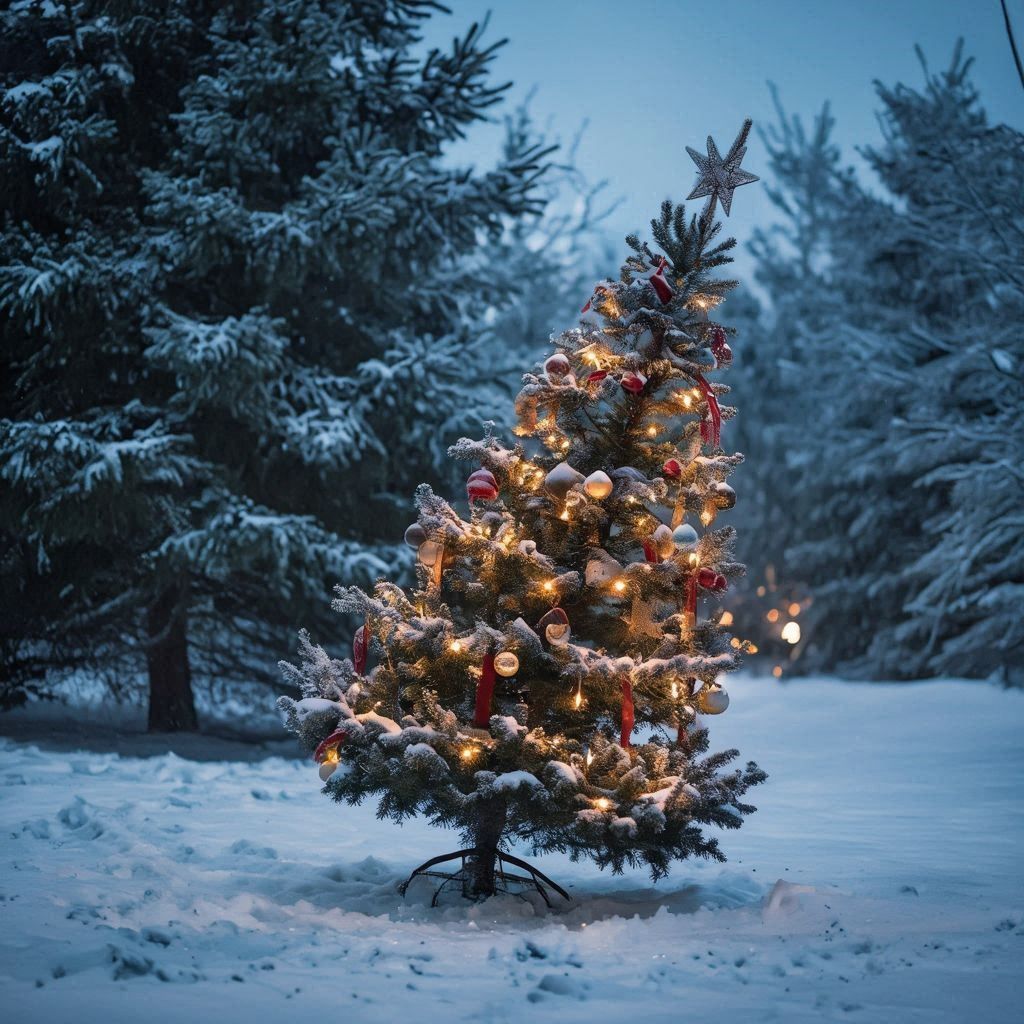
Credit: Bing Image Generator
Share this post via