Persephone
Persephone has returned. Just like she does at this time every year, she is gracing Lightfall Hollow. The picture of innocence, where she walks, flowers trail in her wake. She is obviously happy to be here, and even though she is invariably a handful, I am happy to have her youthful spirit to keep me company once again.
The goddess of spring, Persephone is one of my favorite characters from classical mythology. After winter’s quiescence, she delivers fertility, vitality, and growth to our world.
Flowers fall under Persephone’s divine authority, and they are her specialty. A true anthophile (lover of flowers) with a green thumb as big as all outdoors, her very presence is distinguished by their blooming.
But Persephone is not simply a gentle maiden or sweet young thing. She is reckless, fickle, chaotic, and ungovernable.
Her capricious nature is understandable. For Persephone is not only the goddess of spring, rebirth, and flowers, she is also the queen of the underworld where, along with her husband, Hades, she commands, judges, punishes, and rewards the dead. There, she is commonly referred to as the “Dread Queen,” “Iron Queen,” or “she who brings destruction.” Yet, I cannot help but feel sympathy for Persephone. If you ask me, the stress of having to fulfill dual paradoxical roles – acting as a bridge between two vastly different realms – would cause anyone – even a goddess and queen – to become moody and mercurial.
As formidable and fearsome as Persephone is in her role as queen of the underworld, she does at times demonstrate in that friendless place the sort of kindness and caring fit for a bringer of new life. As “midwife of the soul,” she helps the virtuous make the transition between life and death. She also has a soft spot for lost and confused souls, as well as for those who have died young or suffered cruel deaths, singling them out for special attention.
Presumably, her partiality stems from her ability to empathize with their pain, having been forcibly taken from her mother at a tender age when she was abducted by Hades to live forever in his dreary domain of shadows and shades. Such was the Lord of the Dead’s selfish desire. It did not matter to him how impossibly arduous the transition from bright possibility to gloomy resignation would be for Persephone or how wretched with homesickness the goddess of Earth’s most exuberant season would undoubtedly become in such a dull, joyless environment.
I can only fathom that Hades must have been that forlorn. He must have been desperate for what he saw as Persephone’s and wanted to be his: beauty, hope, bliss, creativity, and an indomitable spirit.
It is fortunate then that Persephone’s mother is Demeter, the goddess of agriculture. A doting and devoted parent, Demeter experienced grief so consuming when her daughter was stolen that she single-mindedly wandered the world, searching for her missing child while neglecting her farming duties and causing global famine. The situation got so dire that humankind was in danger of dying out. Moreover, with their lives dependent upon the worship of mortals, the survival of the Olympian gods and goddesses was likewise threatened.
Under intense pressure from the anxious Olympians, Zeus, as the deities’ king, took charge of the situation and coerced a compromise between Demeter and Hades. Persephone would live six months of every year with her husband in the underworld and the other six months with her mother on Earth. In this way, the four seasons were created. Each year in autumn, Persephone returns to the underworld. As Demeter mourns the loss of her daughter, plant life goes dormant, and Earth begins its slumber that lasts through the winter. Then in spring, Persephone comes home to her mother. As Demeter rejoices, the world awakens and its vegetation flourishes once more until summer’s end.
Of course, Persephone is a myth. Whether I believe in her or not, she has no physical existence. Rather, she exists as a powerful symbol. She represents feminine strength and resiliency, as well as the human ability to embrace all aspects of oneself. She also symbolizes the inseparable interdependence of life and death that gives purpose to being, along with the entwinement of conscious clarity with subconscious murk.
Persephone is nothing other than a symbol. Yet maybe that is why she is so easy to relate to. Because I can understand why someone who spends half their time in a dark place would go a little crazy when liberated to the light. I imagine the grand freedom of it all would make anyone so overpoweringly ecstatic that they would lose self-control and impetuously act on whims.
So between Persephone’s oppressive role conflict and her predisposition for rapturous impulsivity when freed from a bleak world and released to a vibrant one, I suppose I can forgive her for the aggravation she regularly causes me in spring with her messy, unpredictable, and uncontrollable ways. Because, after all, Persephone embodies life and death, and there is nothing more messy, unpredictable, and uncontrollable then life and death.
Yet sometimes I wonder if Persephone is purposedly punishing me with her erratic behavior. Given that spring is not my favorite season, maybe she resents my ingratitude. Be that as it may, I do take enormous delight in my garden flowers and the wildflowers too, and I do find it wondrous in spring when fragile, but resolute shoots begin pushing themselves up out of the barren ground in my gardens and the hollow’s woods.
Beginning sometime in March, the earlier in the month the better, just as soon as it is warm enough to put my hands in the soil, I am out there every day with a pick, shovel, clippers, hand saw, and some superb weeding gadget I do not know the name of. With them, along with what little brawn is mine (not much), I clear debris, remove underbrush, install conservation measures, sculpt the landscape, dig out more garden space, and weed, weed, weed. Luckily, I have a penchant for dirt. (As in soil. Not filth.)
It is hard work, but I genuinely believe it is hard work that has given me my deep spiritual connection to the hollow, my sense of oneness with this land. I swear there is a sort of life-affirming, mystical experience that comes with hard physical labor. A consciousness of a sacred reality. I think the English poet, painter, and visionary William Blake said it best: “Arise and drink your bliss, for everything that lives is holy.”
I further believe that my hard work is valuable. Even so, I do sometimes feel guilty about all the time and energy I devote to my gardening. I wonder how on earth such extravagant gardening on a remote piece of property very few people see could possibly be helping to make the world a better place. But then I think that surely any positive action a person puts their whole heart and soul into is of worth to the world. I do not understand it, but I believe, in some inexplicable way, even unseen positive actions done unreservedly help make the world a better place.
On the other hand, I work so diligently co-creating the land each spring that I break the resolution I make every New Year’s, to take the time to make a physical record of all the co-creative handiworks – not all of them mine – that are here. I especially want a written record, along with photos and preserved specimens, of my garden flowers and the wildflowers that adorn the cabin’s lawns and surrounding woods. But I never allow myself to get to it.
So far, all I have for a written record is a simple, alphabetical list of the common names of the more than one hundred flower types, beginning with Allegheny monkey flower and ending with zinnia. I have yet to make note of when each flower blooms, for how long and in what location, its characteristics and preferences, as well as any scientific information, surrounding myths, indigenous wisdom, or my own observations. The four decades of pictures I have taken are still not organized, and there are many flowers that have never been photographed. As for preserved specimens, years ago, my husband made me a flower press, but I still have not pressed a single flower.
Worse than my lack of recordkeeping is that I do not take nearly enough time to revel in the harvests of Persephone and my labors – to gaze intently and slowly savor the unique beauty of each flower. I always think there will be “next year,” and that is when I will finally give each floral treasure all the appreciation it deserves. Then next year rolls around with way too much to do and a blink of an eye to do it in. Nonetheless, if I do not change my ways, I know someday I will seriously regret all I have missed.
Despite all my transformative work, I try to keep my gardens wild and natural looking. Formal gardens are not for me. I agree with the Irish horticulturist, William Robinson, that the perfect garden is one “devoid of any trace of man.” Although I have not achieved that high mark, I hope my gardens are at least ones worthy of a child’s approval.
I think maybe this predilection comes from my own childhood. Several blocks from where my family lived in a working-class neighborhood, there was for a few years a gorgeous plot of pink and yellow tulips. There must have been several hundred sandwiched in between two sad-looking houses. I loved those tulips and could hardly wait to see them each spring. But one year when I arrived for our annual visit, the tulips were gone. Where they had grown had been paved over to make a couple of parking spaces. I was horrified. In my child’s imagination, I heard the tulips where they were trapped underground, gasping for air, trying to scream for help, suffocating, and dying in the dark. I have never forgotten that, and I think it may be why I let my flowers have their untamed druthers with me.
You would think Persephone would be pleased and maybe even awed by my compassion and the way I indulge her flowers. But apparently not. Since she cuts me no slack.
Take this spring, for example. After a bitterly cold winter – and while I do love winter – I was ready for spring. I was not the only one either. The hungry deer, presumably as a last resort, had not only chomped away at my evergreens – the likes of English ivy, periwinkle, rhododendron, and mountain laurel – but they even denuded of its needles the cast-off Christmas tree that is still lying by the firepit right outside the cabin. In fact, all the plants my uninvited guests helped themselves to are, more or less, right outside the cabin.
Each morning of this past winter, I would find hoof prints in the yard. Despite how indignant I was about the deer devouring the scarce verdure of winter, I had to laugh one snow-covered morning when I noticed that a deer hoof print bears a distinct resemblance to a peace sign made with two stubby fingers. In the snow, it looked like the deer were trying to call an end to winter’s hostilities, signaling the heavens with an unfurled white surrender flag stamped with peace signs.
At first, the deer’s plea for a ceasefire appeared to have worked. Soon thereafter, the weather warmed, and I began my spring gardening. For several weeks, things went like clockwork. Snowdrops bloomed followed by crocuses, Siberian squill, forsythia, daffodils, hyacinths, and Lenten roses. Even the gnawed upon periwinkle swiftly generated new leaves and flowered.
The pussy willow bush, however, gave its usual lackluster performance. Which was particularly disappointing this year. I had tried so earnestly to encourage its blossoming with numerous sharings of a lovely piece of Polish folklore where ordinary bushes growing along a creek rescue kittens from drowning. As a reward, the bushes receive fuzzy, kitten-like catkins and become the pussy willows that are still with us today. But the sweet tale of pussy willow heroism did not move my own pussy willow one whit. Just like in all prior years, it produced no catkins.
Contrastingly, in the woods, as though mocking the pussy willow for its unproductivity, violets, spring beauties, and Quaker ladies heavily carpeted the ground and brought color to last autumn’s fallen leaves. Meanwhile, back in my gardens, the green stems and leaves of Virginia bluebells, bleeding hearts, columbine, and iris stood tall and waited to blossom. And even many of my hostas – of which I have planted dozens of various kinds – had begun to stab their way through the soil with their swordlike tips.
Boy, did that turn out to be a mistake. Because there was a cold snap. The temperature dropped dramatically, and it stayed cold for four killer days. At night, it would go down to as low as the low twenties, and during the day, it would scarcely climb out of the thirties. I thought to myself that Persephone must be in one of her moods. Perhaps brought on by the stress of her recent transition.
At dusk during those four frigid days, I tiptoed about my gardens like a mother tucking in her babes, making snug what flowers I could with scraps of old sheets and towels. But I have too many. Even if I had spent my gardening budget for the next several years to buy more sheets and towels, I still would not have had enough coverings to protect them all.
Miraculously, most survived. The daffodils, hyacinths, bleeding hearts, and hostas took the hardest hits, but the first two will come back next year, and, although the bleeding hearts and hostas were damaged enough to diminish their size once fully grown, they were left with a good chance to still make a decent showing. It is remarkable how resilient flowers can be. Their stubborn survival instinct and adaptability remind me of Persephone.
Also like Persephone, flowers – at least for me – are resistant to control. They seem determined to have their own way, and they usually do. Good examples are my late bloomers.
The prize for my oldest late bloomer goes to a rhododendron. It was a gift from friends of my parents forty years ago. I planted it outside my bedroom window, and for thirty-five years, it grew but did not bloom. Many was the time I considered ripping it out and tossing it on the burn pile. But for some unknown reason, I let it be. Then, five years ago, it began producing stunning flowers of pure white, and it has ever since.
Another late bloomer is the wisteria that has taken over the dilapidated gazebo in my secret garden. Like many of my plants here, I bought it online for ninety-nine cents. Unsurprisingly, for ninety-nine cents, one receives in return a rather puny plant. Nonetheless, the vast majority of my ninety-nine cent buys were terrific bargains from a website that, unfortunately, no longer exists.
At any rate, I nursed that wisteria for fifteen years. I guess because I think there is nothing more romantic than a rickety gazebo held together by braided ropes of wizened wood and dangling chains of lavender blossoms. But for all my trouble during those fifteen years, the wisteria, like the rhododendron, grew but did not bloom. That is, until two years ago.
The yellow flag irises are also included among the late bloomers. As I was then unaware that such irises are invasive, I planted one at the edge of the pond over three decades ago. It bloomed for a couple of years and then disappeared. Presumably, a muskrat had it for dessert. A decade later, not only did that lone iris reappear, but a massive colony of the same came up with it. Hundreds upon hundreds encircled the pond. Far too many to rip out by hand, they are still here.
I know I should feel remorse for my dumb mistake in planting an invasive plant, but ever since, when the yellow flag irises bloom in mid-May, I feel like I am living in one of Monet’s paintings of those sunshiny flowers. It is difficult to feel guilt and regret when one is captivated by beauty and soothed by serenity.
Two other late bloomers are the oriental poppies a friend gave me and the Virginia bluebells another friend gave me. Both did barely anything for close to two decades, but this year when they showed up, I was delighted to see they had multiplied like there was no tomorrow.
The poppies have yet to bloom, but they are in bud with hairy green pods that will soon split open to turn loose brazen flowers of garish red-orange that sashay and shamelessly flaunt their wares for every passing son of Zephyrus (aka Greek god of the west wind). A friend of mine calls such poppies “floozies,” and that word does capture their mien.
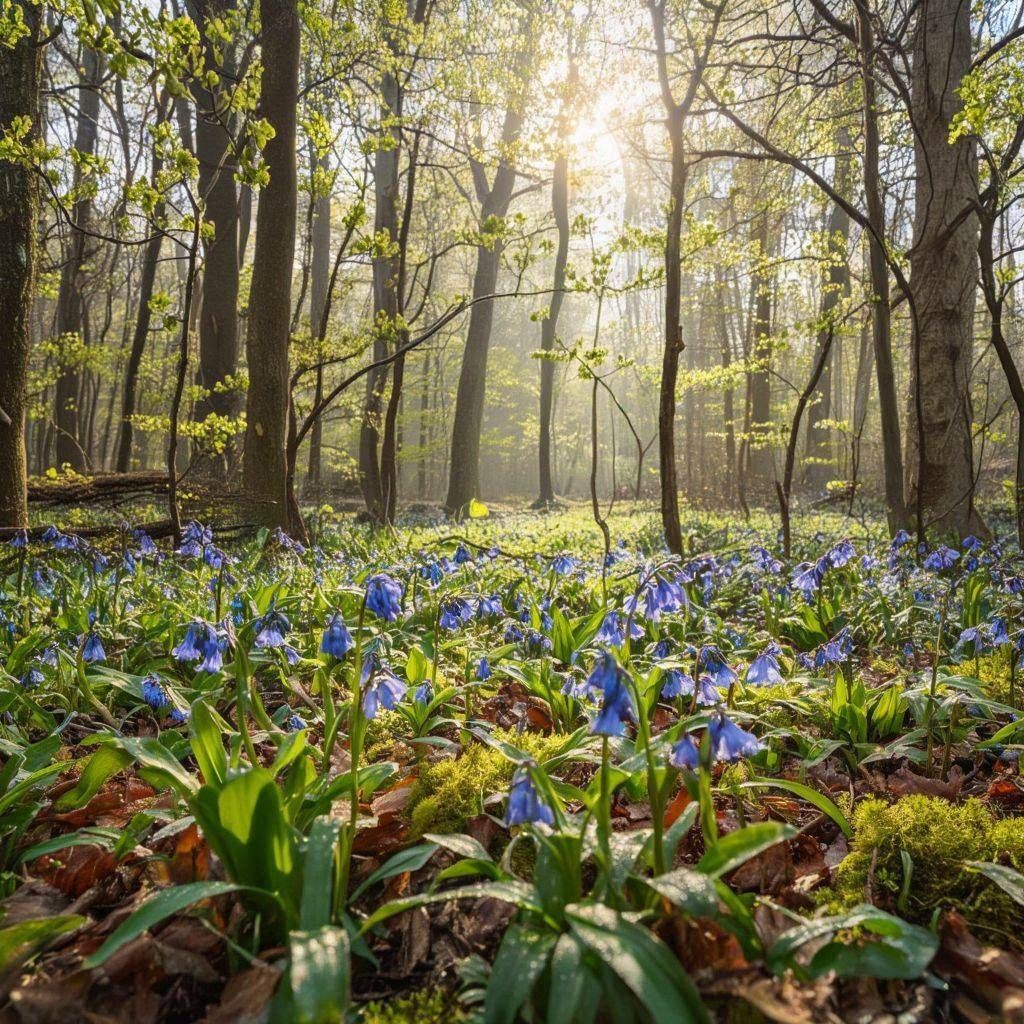
As for the bluebells, although they are almost finished blooming and despite Persephone’s caprice, I am especially gratified by how well they performed for the past few weeks. Bluebells have come to mean something special to me ever since I long ago acquired a large oil painting of a young woman kneeling in prayer, surrounded by a woodland filled with blooming bluebells.
It hangs above the cabin’s woodstove and is close to being my all-time favorite material possession. The artist titled his work Woodland Prayer, but from the first time I saw that painting – even though her face is hidden from view, and she wears modern-day clothes – I recognized that young woman as Persephone. In my mind’s eye, Hades has just burst forth from the underworld, his gold chariot pulled by obsidian-black horses with nostrils and eyes that smolder with a violent red. Persephone, terrified, drops to her knees and prays.
In the Homeric Hymns and other ancient myths, several different types of flowers are said to be the ones Persephone was picking when she was abducted by Hades. Never mentioned, however, are bluebells. But I can easily imagine that they were bluebells, and, interestingly enough, in some more modern retellings of Persephone’s abduction, the flowers that distracted the young goddess and left her vulnerable are bluebells.
The choice of bluebells in modern retellings makes a sort of sense to me since bluebells have long been associated with fairies. Fairies, like Persephone, are said to act as a bridge between two realms, our human world and the magical world. Often that magical world of fairyland is said to be located underground.
Of course, fairies, also like Persephone, are mythical creatures. However, what is not a myth is the comfort and strength the goddess of spring’s story and the “Persephone” painting gave me during a time when I was in my own bad place. They conveyed a deep psychological and spiritual meaning that provided me with hope when I needed it most. In a way that I do not fully understand that story and that painting became my ultimate reality, and they kept me going when I thought I could not.
I suppose that is why beneath bluebells is where I want to be buried someday. Preferably, naturally, wrapped in a simple cloth shroud and allowed to decompose beneath the earth.
Another reason for my final wish is because, according to folklore, bluebells when rung summon fairies to their dances. I am enchanted with the image of my remains being that upon which the Good Folk and People of Peace trip to light fantastic.
I realize to some my wish for my body to return to the earth without chemicals or cremation may engender a gruesome picture, and I can sympathize with their squeamishness.
I know there are people who cannot even bring themselves to view an embalmed and, albeit temporarily, preserved body. Which does baffle me. After all, death is not catching, and, as countless numbers of humankind have proven, all the best people do it.
Being both a longtime gardener and woodswoman, I have gotten quite familiar with decomposition. I have witnessed the rotting away of countless dead trees and other plants, and I have frequently come across the corpses of decomposing animals. In some of those cases, I have returned to the death scene multiple times so I could study decomposition from start to finish. And, yes, the dismantling of a living creature’s body is gruesome. But if observed long and intently enough, I have found that human sight can move past the repugnant physical to something too metaphysically beautiful for words.
My desire for my dead body to decompose naturally is because I love this world. It has nourished me with an eternity of what is wondrous and good. Therefore, as my last earthly act, I would like to return at least a tiny little bit of that immeasurable favor and have Earth feed upon me as I have fed upon it. (Well, that and I get a kick out of envisioning fairies making merry upon my late-blooming carcass.)
But enough about the art of late-blooming. Except that I do want to say something about those of my flowers that have yet to ever blossom. About them, I remain hopeful. Remembering their late blooming peers, I am not inclined to give up and yank them out of my gardens. At least, not yet.
Another example of flowers with Persephone-like qualities are the volunteers. They include the twenty or so wildflower types I never planted but which apparently decided on their own that they preferred a life less spartan and thereby took up a more pampered existence in my gardens. While some of my crocuses, Siberian squill, and daffodils concluded the opposite. Those rogues chose to leave home and now live free out in the woods—where, I must admit, they give me as much pleasure as they would confined to my gardens. Finally, there are those flowers, like the rascally black-eyed Susans, cone flowers, daisies, forget-me-nots, widow’s tears, and several others that apparently like to garden-hop late at night when I am asleep and not looking.
I can almost believe that absurd notion since it has been my experience that, also like Persephone, flowers have a hidden life and do mysterious things. Besides my garden-hopping rascals, another case in point is the St. John’s Wort that mystifyingly appeared among my garden plantings surrounding Mabel, the old giant of a maple tree outside my front porch that was downed to a jagged remainder of a trunk by a windstorm a few years ago.
I had just finished writing about St. John’s Wort (aka Chase Devil) an hour or so before. It is a sun-loving wild plant that thrives in the poor soil of disturbed or neglected areas, like roadsides or abandoned fields. I assumed it was this preference for the impoverished ground of blighted landscapes that prevented St. John’s Wort from growing in my fertile gardens the many times I had tried to get it to do so.
For years, I had tried, and then out of the blue, through no effort of my own, as if by magic, there it was. While I realize seeds can sometimes lie dormant in the dirt for years and then finally sprout for no obvious reason, this St. John’s Wort was a large one. It towered over a crowd of large, shade-loving hostas that I regularly tend. I don’t know how I could have possibly missed it until then or why it would choose to grow both in the heavy shade and rich soil it naturally disdains. I would like to think that St. John’s Wort grew itself as a thank you gift for me in exchange for my love note to its kind, but that is a cuckoo thought.
Another cuckoo thought – and I do have them, a lot – is that maybe it is Mabel who is at the center of the mystery. I have further reason to suspect that old tree relic of playing practical jokes on me because of another puzzling incident involving the seventy-five gold and purple crocuses I planted around her last fall. The crocuses came up when they were supposed to just fine, but here is the weird part.
Only the gold crocuses bloomed where I had planted them in clusters around Mabel. All the purples popped up elsewhere. Each bloomed in its own solitary spot, and they were quite scattered from one another. Some ended up as far away as the woods on the other side of my secret garden, which is at least a winding football field from Mabel. How could that possibly have happened? Well, maybe because, again like Persephone, crocuses are not only covert and inscrutable, they are defiant.
Crocuses, like snowdrops, can push up through frozen soil and bloom in snow. I remember a great lady I once knew who said that coming upon jewel-like crocuses blooming in a white landscape was “thrilling.” Back then, I failed to ask her why, but now I think it was because the lady herself was a bit of a rebel. Consequently, she understood that crocuses cheerfully blossoming in defiance of grave winter creates the thrill of hope in human hearts.
The crocus rebellion is a reassurance that the renewal of life the spring season represents is inevitable. That while we humans and our world are not, life itself is eternal. Somewhere, somehow, life will always go on. In this I take great comfort and thank the wise lady for her insight.
Yet there is no denying that the way the crocuses I planted last fall came up this spring all over the unintended place is defiance gone over the top. Still, the crocuses’ outlandish conduct does not weaken my conviction that defiance in some measure is good. It can create toughness, and to survive, flowers, like any other living beings, need to be tough. Particularly if they are going to survive the whims of Persephone.
As demonstrated by this spring’s volatility. Because no sooner had my gardens endured four days of untimely cold than the hollow was blasted with unseasonable heat, causing numerous flowers to make their initial appearance way too soon, and others already in bud or bloom to zoom through their blooming far too quickly. True, in spring, every flower blooms for too short a time, but the breakneck speed recently exhibited by many is ridiculous.
To make matters even more challenging, yet another cold snap immediately followed the warm spell. This one was briefer at least, lasting for a couple of days with only one night in the mid-twenties. For which I again made twilight rounds in my gardens, tucking in flowers with torn pieces of towels and sheets.
As before, most of the flowers and other plants too weathered the aberrant cold unharmed. Even the bleeding hearts pulled through with no additional damage. Probably because I had covered them more snugly. The two exceptions were the painted ferns and astilbes. Both had surfaced after the first cold snap, only to shrivel and turn an umber brown during the second. I assume they are goners. Well, at least until next spring.
Concerning the hostas, because they were further developed than during the earlier freeze, they were far more heavily damaged. After thawing, most were reduced to what looked like glops of melted ice cream or the Wicked Witch of the West after Dorothy had finished with her. I seriously doubt the hostas are going to amount to much of anything this year.
But that is okay. As proud as I am of my hosta collection, for a few years now, the deer have been dining on them more and more. Last summer, they ate practically every single hosta down to a pathetic stub. They even gobbled up the ones I risked life and limb for by planting them on a steep hillside. (A death-defying attempt to artistically recreate a waterfall from Pennsylvania’s Ricketts Glen State Park with cascading blue and green hostas.) To spare myself further frustration – while once again perhaps risking an early demise – I was already thinking of replacing the hostas with plants less relished by deer.
That is just the way it is with gardening. A gardener is someone who is constantly battling the natural world, and a good many times, the natural world wins. Yet, in my experience, for every few losses, there is a win or, even better, something given with no strings attached that is so intriguing, exhilarating, stirring, mesmerizing, beautiful, amazing, or inspiring that it immerses the senses, frees the mind, and pumps up the heart.
And at least the natural world is natural. Not so the climate change caused by humans that now must be contended with too.
Granted, cold air surges have long been a normal part of springtime in the Alleghenies. The atmosphere is in transition between winter and summer. There are clashes between lingering cold air masses and arriving warm air masses, and sometimes the cold gains the advantage for a bit. The recent cold snaps could just be par for the course, or metaphorically, the result of Persephone’s usual vagary.
But the cold snaps may have also been due to the increasingly weakened polar jet stream above the eastern United States, the result of unnatural and extreme warming in the Arctic that keeps allowing colder air to dip south, making temperature swings more extreme.
As for “false springs” – where temperatures rise too early, causing plants to start growing prematurely and be susceptible to damage once temperatures fall again – they have also been historically common. However, they are occurring much more frequently here in the Alleghenies, and global warming is almost certainly the culprit.
So as if competing with the natural world and coping with Persephone’s spontaneity were not enough, now climate change is adding to the struggle.
Still, despite being outnumbered, along with all the defeats and disappointments that come with flower gardening, I will keep fighting the good fight. Because the flowers are worth it. Their blooming reminds me that life itself is for blossoming. And that is no myth – it is a fact to hold onto for dear life.
And now I have to go cover some flowers. As it is going down to freezing tonight.
Damn you, Persephone! Go to hell.
(Just kidding. I love her.)
Credit: Bing Image Generator
Share this post via