High Summer
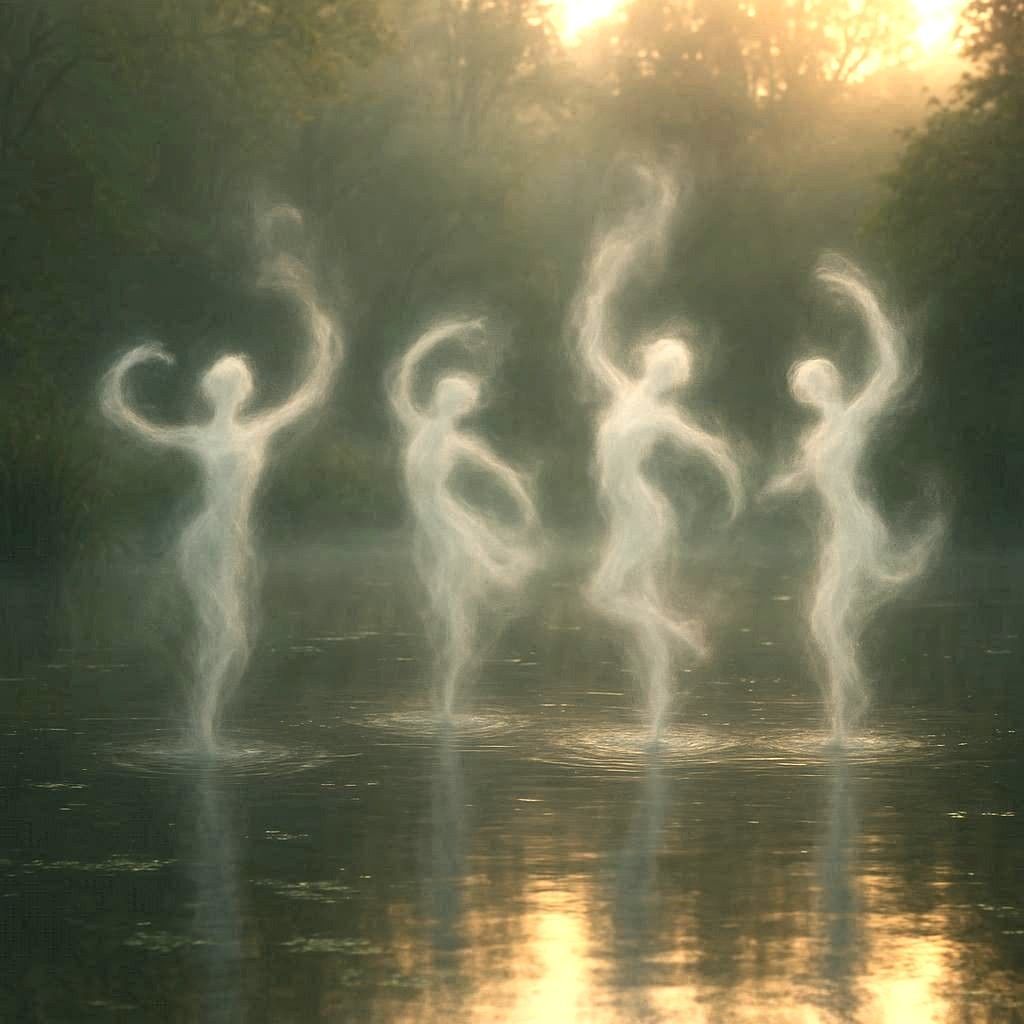
Fog cloaks the hollow. Which means fairies are on the move. At least that is what my Celtic ancestors of Scotland and Ireland would say. It was their belief that when “The Good People” travel the Earth, they hide themselves with a magical mist impenetrable to human eyes.
The Celts also believed that a region where mist and fog are commonplace is indicative of a “thin place,” a location where the fabric between our world and the supernatural world is as close to transparent as it gets. No wonder then that Appalachia, with much of its culture influenced by people of Celtic descent, along with its mountains regularly draped in a gossamer mist or dressed in a heavy fog, is viewed by many, native and non-native alike, as a region where otherworldly beings reside and unearthly things happen.
Whether or not that notion is true, as I look out at Lightfall Hollow on this high summer day, the woods all gussied up in a silvery, cobwebby garb, it is easy for me to imagine, perhaps because of my own Celtic roots, that fairies are out and about. I wonder why.
My first thought is that they may have finally had it with this seemingly endless cycle of severe weather. Days of sweltering heat and humidity, followed by days of electrical storms and torrential rains. Only to repeat, like a broken record.
For a moment I worry the fairies are running away from their alternately steamy and soggy home in search of new horizons. But that is a silly thought. Like me, the fae are spellbound to the Appalachians. Neither they nor I will ever leave these haunted mountains.
Moreover, in some Celtic folklore, fairies are said to control the weather. If that is indeed the case, rather than departing the hollow in a huff, it is much more likely they are lingering about, gleefully conjuring up yet another thunderstorm.
I think I understand. Because there is something about a thunderstorm that excites the imagination, and fairies are all about the imagination. I wonder if, when lightning flashes and thunder crashes and rolls, they summon what I imagine.
What I imagine are sky giants working in a celestial quarry. As the giants blast stone apart, the resulting blaze is lightning. The deafening sound of rock shattering is thunder’s boom, and its rumble is the broken stones tumbling over one another as they somersault down the highlands of heaven.
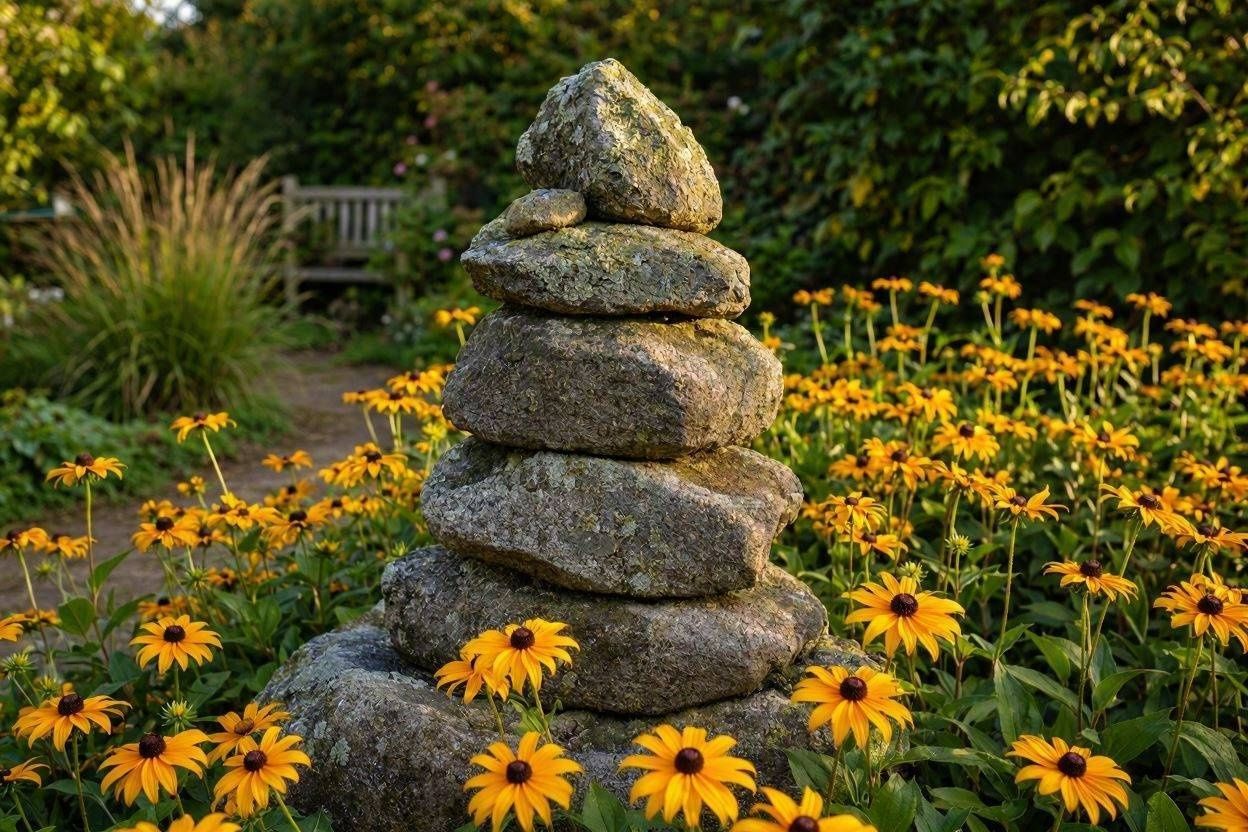
According to Celtic folklore, fairies have a strong connection to rocks and stones. Ancient stone structures, as well as natural rock formations in Scotland and Ireland, are often attributed to their creation. So it would seem fairies are as crazy for rocks as I am.
I truly do have a passion for rocks. Especially when it comes to utilizing them to make something new. Thus, the stacked stone wall that lines the hollow’s creek, cairns in my secret garden, and campfire ring that sits atop the pond’s bank. All are native stone designs, however amateurish, of my handiwork. Then there are the raw rock pathways, ouroboric loop, and patios my husband and I laid, as well as the cava cave (aka hobbit house) my husband built that failed as a root cellar but triumphed as a work of art.
It is never enough when it comes to me and rocks. Now I am borderline obsessed with building yet another stone structure from what was originally intended to be a second fire pit, this one at the wooded edge of my secret garden. But after I had assembled a rock circle with a diameter of approximately fourteen feet and a circumference of about forty-four feet, I realized how downright stupid it would be to have campfires, much less bonfires, in what is essentially the middle of the woods where my garden hose does not reach. As I am not a total idiot, I abandoned the project.
But lately I am drawn to that forsaken ring of stone. I know it can be more. Although I have yet to comprehend what that could be. A prayer circle perhaps?
I am envisioning two concentric circles with a narrow entranceway of steppingstones cutting through a large outer ring and leading to a small inner ring in the middle of the larger one. The outer ring is a curving stone wall, about two feet high. Except for the opening for the footpath, it completely encloses the inner ring. The inside of the inner ring is empty of rocks, lined with a forest green hassock of moss, and just big enough for a worshipper to kneel. I wonder if that is a good idea.
I do not know. As usual when it comes to me working together with stone, I shall have to wait until my rock colleagues grant me an answer.
That stone can communicate is wildly imaginative. I suppose the surreal impression largely comes from my fascination and familiarity with the hollow’s endless supply of nature-made rubble, most of which can be found in Tadg Run, the little creek that babbles nonsensical rhymes as it rambles past my cabin. As to why I am bonkers for rocks, I figure this madness of mine is due, at least in part, to the enduring influence of people who lived in Scotland and Ireland and died long before I was born, the earliest of these predating the Celts.
Scotland and Ireland are full of ancient stone structures. Most of which were built by farmers in the Neolithic Period (New Stone Age) at least three thousand years before Celtic culture developed and dominated the two countries. Nonetheless, the Celts revered the stonecraft of their distant predecessors, weaving the prehistoric constructions into their folklore as sacred gateways, sites of power, sanctuaries, and abodes for the gods and other supernatural beings, including fairies.
Even today, in both Scotland and Ireland, there is a profound cultural respect for these ancient stone relics. Modern populations proudly regard them as part of their historic and mythological heritage, and they protect their rock monuments like the ancestral treasures they are.
Which leads me to suspect that there is a fair chance I am not the only one to ever converse with rocks. I do not know about the prehistoric farmers and stonemasons of Scotland and Ireland, but from what I have been able to gather, the Celts believed all things in nature have a spirit. I believe that too. I feel it always. Sensing life in everything, including what is inanimate. And what is alive communicates. Even if it appears stone cold dead. Like a rock.
Appearances aside, rocks are not static. They change and progress. They are active participants in Earth’s geological evolution. Those that are in the Alleghenies are the result of tectonic crashes and a seabed that got compacted hundreds of millions of years ago.
Their current state is not the end, however. Eventually, the rocks will break down to form soil. Without which there is no life.
Still, I will admit, it is odd for a person to claim that rocks are capable of discourse. It is just that, when I am building something of stone, as I sort through rocks from the creek bed, I swear I can sense each rock I consider for my scheme telling me, not with a voice I can hear, but with a subtle, barely perceptible feeling – like a slight, gentle nudge – whether or not they want to be a part of my endeavor. Those who are amenable also let me know with the same ethereal feeling where they should be placed.
Undeniably, an over-the-top fancy. But from my perspective anyway, true. And I would hope from the perspective of others who differ, pardonable.
After all, upon us now is high summer, a season for enchantment, childlike playfulness, and openness to the impossible.
Under its rhapsodic spell, all of nature is in a frenzy making magic. Take, for instance, my daylilies. For the past few weeks, they have been going like gangbusters, greeting me each morning with two to three hundred new blooms. As I walk among them, as if in a beautiful dream, they beguile me with their various shapes, sizes, scents of certain ones, and especially their many different colors that range from soft to luminous to intense. Sometimes all in the same flower. How lovely too are the juxtapositions of the summer-hued daylilies along the creek with the autumnal gold and brown of black-eyed Susans and the motley of daylilies on the pond bank with the spring blush of fairy roses.
I have been lucky with the daylilies this year. The deer have yet to eat a single one. (Knock on wood.) I do not want to get my hopes up too high, but I have been alternating environmentally safe and cruelty-free deer repellents, and my strategy appears to be working. Each evening, as close to nightfall as possible, I lightly spray the daylilies and their surrounding area with one of three different types of deer deterrents, two of which are homemade. Except for not being able to find a sprayer for my DIY concoctions that does not quit working in a frustratingly short amount of time, so far, so good.
I wish I could say the same for the hostas, another favorite delicacy of those moocher deer friends of mine. Because I did not protect them sooner, quite a few that escaped being leveled by April’s hard frosts have since been gobbled down to the ground by ravenous cervids.
It has become painfully apparent it is time to let go of at least some of my hostas, particularly those in the garden I planted around Mabel, the gigantic, old maple tree a windstorm toppled a few years back. Between this spring’s unseasonable freezes, the nonstop deer foraging, and a significant decrease in shade since Mabel’s departure (not to mention, when Mabel fell, she smushed her cohabitants flatter than a failed chocolate mousse), it is clear the long-suffering hostas wish to give up the ghost. So it is only right I oblige and send them off to their reward in greenery heaven, and, sadly, I shall.
In anticipation of my loss, I have already begun replacing the dearly departing with Lenten roses in white, pink, and burgundy. Since I have an overabundance of astilbes in my secret garden, I will transplant some as more replacements next spring. I will probably also splurge and buy more Japanese painted ferns. I love them so. No matter how hot summer gets, they cool me off with their frosted, wintry appearance. And there are always the Christmas, lady, and maidenhair ferns the woods gives out for free.
Lenten roses, astilbes, and ferns are supposedly unpalatable to deer. This is also assumed to be true for the other plants (except for the hostas), that have come to encircle Mabel over the past forty years. The wild geraniums and violets, as well as the cultivated snowdrops, crocuses, clematis, balloon flowers, wormwood, columbine, and lithodora. While I maintain a healthy skepticism of all claims about any plant being “deer proof,” to date, the above do seem to be safe from the ravages of whitetail voracity.
So it is wholly probable that next year the deer will turn up their noses and hoof it out of Mabel’s garden. Although when it comes to what makes deer mouths water, I never know for sure. Over the years, the plundering beasts have feasted upon plenty of my plants that are professed to be offensive to their tastebuds. Perhaps someone should instruct the poor, dumb dears in yuck determination.
Nor do I ever know for sure about practically anything when it comes to plants. So often they astound me with their tomfoolery. Examples from the past several months are the astilbes and painted ferns I thought were goners after they were reduced to shriveled brown carcasses by April’s cold snaps. Turns out, it was a prank. They were only playing dead and are now looking more lushly alive than ever.
Then there was the towering St. John’s wort that rather startlingly appeared last summer in Mabel’s garden, doing so all by itself and after years of my trying to persuade the willful plant to take up residence in a more conducive spot than the location it chose. Its dead stalk is still there. I have not dared to touch it. But that is all there is. It neither propagated nor returned.
Another surprise from the sunny, but perverse little flower arrived just last week. For the past few years, I have noticed a plant living in the hollow and at Stone Harvest that has blooms very much like those of St. John’s wort. I honestly didn’t think much about it. Many plants look alike. At least to me.
Enough so that, more times than I care to admit, I have weeded out plants I want but mistook for undesirables. One of the worst was when I dug up a plot of oxeye daisies. Another was when I removed a patch of Queen Anne’s lace. Just the other day, I may have destroyed a bed of goldenrod.
It is therefore applaudingly shrewd of me to have finally gotten around to putting the iNaturalist app on my cell phone. With it, I was able to take a picture of the presumed imposter and find out to my astonishment that it too is St. John’s wort.
I have been fascinated by St. John’s wort for decades. It is widely classified as a medicinal herb, used for thousands of years in multiple places around the world. A tincture made from its flowers and buds is said to ease mild depression and anxiety.
I have made that tincture. However, not for its supposed remedial properties. I am relatively ignorant when it comes to dietary supplements and am wary about ingesting any without the advice of a healthcare professional. It was solely out of curiosity that I made the tincture. I wanted to see if the yellow flowers and green buds, when crushed and steeped in alcohol, would turn the liquid crimson. As I found out, they do.
The red pigment I extracted from St. John’s wort came from the chemical compound hypericin. It is contained in glands on the plant that appear as tiny, dark dots. According to old, Christian mythology, the red of hypericin symbolizes the blood of John the Baptist when he was beheaded. While St. John’s wort’s equally tiny, translucent oil glands are said to shed tears each year on August 29th, the avowed anniversary of the saint’s martyrdom. But a weeping St. John’s wort I have yet to witness. I will have to mark August 29th on my calendar.
(Incidentally, while only Christians consider John the Baptist a saint, he is additionally revered as a prophet by Christians and Muslims alike. Along with the followers of the Baha’i and Mandaeism faiths.)
It is not St. John’s wort’s purported curative powers that have captivated me. It is all the stories it has inspired over the millennia. The flower is featured in the ancient mythology of Greeks, Romans, Celts, Teutons, and, as just mentioned, in the medieval folklore of Europeans and the early folklore of Americans.
Today, St. John’s wort continues to be woven into the stories found in a number of novels. That dinky, modest, inconspicuous plant is an affirmation that, not only does everything have a story, but a story can flower from any seed. Provided the seed lands in fertile, open ground, of course.
Being such a fan of St. John’s wort, prior to my discovery, I did realize it is not indigenous to the United States. However, what I did not know is that United States has over thirty native species. The one here in the hollow is spotted St. John’s wort.
I cannot help but conjecture the reason I have been unable to grow what I assumed was the lone one of its genus was because it has been messing with me. All this time, it has been teasing me and laughing behind my back at my lazy benightedness.
The final amazing thing about my most recent adventures with St. John’s wort is that, after I made my discovery, I suddenly began seeing the nonnative species in places where I had never seen it before and where I would be willing to bet I had already looked. Whether this is the result of the psychological phenomenon known as frequency illusion (a cognitive bias that causes the brain to selectively focus on something and think it is everywhere) or good old magic, I do not know. In any case, I am hopeful the inspirer of myriad tales throughout the ages is at long last done with making fun of me and wants to be friends. So all is forgiven.
Two other flowers that are making their fair share of magic these high summer days are the oxeye daisies and black-eyed Susans. Both have spontaneously taken root in the gaps between the stones in the patio alongside the cabin, nonchalantly building a rock garden where I would have had to work my fingers to the bone to do the same. Yet, the result of my toils would never have been so natural looking.
As delighted as I am with my new rock garden, I cannot stop thinking that the daisies and Susans are in cahoots with some columbines that this past spring did the same thing with the stone path out back. It is terrific that first-rate landscaping has appeared without me having to lift a finger, but I am beginning to think that there may be more shenanigans involved than wonderworking. Because it does sort of feel like the columbines, daisies, and Susans are cutting me down to size, flaunting in my face that they are the superior gardeners.
Well, they will get no argument from me. I humbly acknowledge that Mother Nature’s flower children have the world’s finest green thumbs. Never shall I come anywhere near close to surpassing those virtuosos in the gardener’s art of enchantment.
The black-eyed Susans have also popped up en masse along the creek, as well as in the drainage ditch next to Mabel’s garden. I have tried and tried to turn that ditch into something aesthetically pleasing. I have broadcast several kinds of flower seeds there. None of them grew, and none of them were black-eyed Susans. Nor did I plant black-eyed Susans along the creek. The closest black-eyed Susans to either creek or Mabel I planted are in my secret garden, at least three hundred feet away.
It is rather like what happened with the purple crocuses I planted around Mabel last fall that, in spring, showed up everywhere but around Mabel, including at the far end of my secret garden. Perhaps the crocuses and black-eyed Susans amused themselves this past winter by planning to swap places, all for the purpose of driving me batty with their skulduggery.
Once more, it feels like I am the target of flower mischief, and increasingly, I am becoming convinced the main culprits are the black-eyed Susans. I would not be at all surprised if those hellions have a plot afoot to take over every square inch of Stone Harvest’s grounds.
Additional evidence of such subterfuge is how the Susans are fighting and beating out the other flowers in my secret garden, invading and claiming territory from the cone flowers, shasta daisies, coreopsis, veronica, pink muhly grass, Russian sage, lavender, bee balm, and mother of thyme. I must say, with all the tussling they do, the Susans deserve their black eyes.
Then again, those wild child Susans of mine remind me of Norman Rockwell’s 1953 painting The Shiner, where an elementary schoolgirl with a black eye, who has obviously just been in a fight, sits alone on a bench outside the principal’s office, waiting to be scolded and perhaps even punished.
But all on her own with her wide grin, messy hair, straight shoulders, rumpled clothes, untied shoelace, and pigeon-toed feet, that little girl destroys the enchaining feminine stereotypes of the 1950s and before that dictated females of all ages be docile, dependent, and tidy.
I like that child. As she awaits her fate, she is not contrite and scared. She is proud and defiant. I am wonderstruck by her shining example. So it is only natural that, no matter how much they vex me, I will always feel fondness and admiration for my own black-eyed, sassy rebels.
As for the pigeonholing of females, or anyone for that matter, it is demeaning twaddle that some miscreants in our country are presently hellbent to revive and legislate. But their assaults to make subordinate me and a treasure trove of others are ultimately doomed. Because always among us will be the shiners.
Another spot here at Stone Harvest where magic is occurring is on the steep hillside behind the cava cave (hobbit house) where I attempted to create a cascade of hostas in homage to the waterfalls at Pennsylvania’s Ricketts Glen State Park. My artistic endeavor started to work, but then the inartistic deer scarfed down what would have surely been my gardening masterpiece.
Yet, it now appears all is not lost. A wild herbaceous plant, forked nailwort, at one time used to treat nail infections and allegedly unappetizing to deer, is apparently having a go at the same thing. Though a tiny groundcover, it looks as frothy and effervescent as any waterfall. If it completely floods the hillside, I believe I will finally get my gardening masterpiece.
And so what if a more talented artist than I gets the credit? I learned a long time ago it is not the dreamer that is important, it is the dream.
High summer is transpiring, not just in my gardens, but in the pond as well. There, beginning at sundown and going on until daybreak, male frogs hold a nightly belching contest in hopes of attracting their lady loves. It strikes me as a funny way to persuade a potential inamorata that you are Prince Charming, and I have to chuckle. For which I am grateful. Since there is no more potent send-off to a sound sleep than a good laugh.
Be that as it may, I have repeatedly reminded the amorous amphibians that they share the pond with others and should try to be good neighbors. It may be they are distressing the peace-loving koi with their peace-disturbing antics, as well as teaching bad manners to the little, innocent painted turtles and bluegill fish. I have warned the frogs as well, cautioning them that they might be annoying the snapping turtles and northern water snakes. Predators who might choose to end their princely charming by turning them into midnight snacks.
Not that the snappers and water snakes are bad actors. I would never say that. Both perform important environmental services. Snapping turtles mostly eat sick, weak, or dead fish, small animal pests, and aquatic weeds. When they are juveniles, they also eat insects, like mosquitos, and their larvae. In short, snapping turtles help keep a water body healthy and full of life.
Not too long ago, I had an incredible experience involving a snapping turtle. As I do every morning, I was feeding the sixteen koi my husband and I released into our pond a few years ago, intending that the domesticated carp feed upon the thick layer of algae that was then entirely covering the pond’s half-acre. It worked. Within weeks, the algae disappeared, and we have not seen a single strand since. Which is why we supplement the koi’s diet with store-bought fish food.
Anyhow, a few weeks ago, I was feeding the koi their kibble, and a gigantic snapping turtle pushed his way into their banquet. I immediately felt sick to my stomach. I thought for sure I was about to see blood in the water as the snapper viciously attacked one or more of the peaceable koi. But that is not what happened. The snapper simply helped himself to some kibble and then departed, leaving plenty of uneaten chow for the still dining koi. As for the koi, their formidable intruder did not appear to faze them in the slightest. Nor did they seem to care that they had shared something they wanted with a being not of their own kind. Compelling me to think that pacifism may have a chance of working.
Regarding water snakes, just like snapping turtles, and all snakes really, they are misjudged. At least in Western societies like ours. Where most of us are taught that snakes are evil incarnate.
Not so everywhere though. In quite a few cultures, snakes, because they shed their skins, are viewed as symbols of rebirth and transformation, discarding what has been outgrown for what is larger.
On a practical level, water snakes, again like snapping turtles, act as both disease and pest control. The same is true for nearly all snakes, including venomous ones, which northern water snakes are not. Many of America’s most precious lands would be overrun with vermin were it not for our snakes.
But I digress, and I want to get to another high summer enchantment. Which is this. As the frogs of the pond perform their nighttime courting ritual, the lightning bugs or fireflies of the forest are doing the same. But unlike the coarse racket the frogs make with their wooing, lightening bug seduction is silent and exquisitely visual. Especially when the bioluminescent beetles fly high up in the air and their flickering lights appear to mingle with the twinkling stars. The magic of any spell in any season does not get more spectacular than that.
I often think I could never live anywhere that does not have lightning bugs, but I may have to. Worse, and more probable, future generations of Appalachians may have to. Our firefly populations are dwindling due to habitat loss, light pollution, pesticide use, and climate change. Most impacted are localized and specialized populations, but if we keep going the way we have been, widespread decline and eventual extinction of Pennsylvania’s state insect is quite possible. That horrific fact makes me horribly downhearted.
Fireflies not only mesmerize on high summer nights in Appalachia and elsewhere, they also entrance by way of the folklore of Southern Appalachia and several different countries, where they are generally portrayed as either the messengers or souls of the dead.
I have tried to track down some Northern Appalachian or Alleghenian folklore about lightning bugs but have not had any luck in doing so. Although that does not mean such folklore does not exist. I just have yet to discover it.
Consequently, because of my Celtic roots, I searched for what the folklore of Scotland and Ireland has to say about fireflies. Which is absolutely nothing, since neither country has any fireflies. Nonetheless, Scotland is at least home to their glowworm cousins.
Both kinds of beetles belong to the same insect family, Lampyridae. However, there are major differences. While female glowworms are bioluminescent, they are wingless, and the light they emit is steady. As for the males, they have wings, but no lights. Though, for some inexplicable reason, the Scots still refer to them as glowworms. Perhaps because it would be cruel to call them unenlightened worms.
Happily, I did locate some Scottish folklore about the country’s glowworms. The Scots say they are fairy lamps, lanterns that light the way of the nighttime wanderings of “The Good People.”
I found that image appealing, and it made me look harder at the lightning bugs that frequent my neck of the woods. Right away, I knew there was no way I could even begin to pretend that they are fairy lanterns. All that continual blinking would make them unreliable, exasperating, and maybe even dangerous torches.
Next I tried associating lightning bugs with the fairy-manufactured mist of Celtic lore. A possible connection between the two made sense to me since Celtic lore asserts fairy mist obscures human vision to conceal supernatural movements, and I thought it conceivable that lightning bugs, by bedazzling human eyes, could be seen as serving the same camouflaging purpose.
But that crumb of imagination failed to satisfy. So I took another hard look at my Alleghenian lightning bugs, keeping in mind that other people in different locations have related them, one way or another, to the dead.
That is when my very own vision appeared, and I could see lightning bugs, not as the messengers or souls of the dead, but as the souls of those yet to be born.
Some pulsate rapidly. Those are the adventurous souls who cannot wait to jump into the harrowing fray that is life on Earth. Others pulse slowly. Those are the more timid souls who are hesitant to expose themselves to so much pain.
To them I would say you are right to be reluctant and even afraid. Life will make you suffer. It will make you suffer to an unimaginable degree. But life in this world is so beautiful. To have it even for a moment is worth the heartbreak that comes with the miracle. Do not miss out on life. It is only with life that a soul can obtain what is everything and what nothing can ever take away.
But enough about lights that belong to the unseen.
After nighttime has ended and it is day, the woodland birds fill the waking hours with their own expressions of passion, starting with a dawn chorus. There is such a wide variety of avians in Lightfall Hollow. Ten minutes of running the Merlin Bird ID app on my cell phone any time before dark May through August typically identifies fifteen or more different birds.
Although it will not be long before most of my fine feathered friends depart for warmer climes, like the snowbirds they are. I will hate to see them go. I will especially miss awakening to their early morning harmonies, as well as to the cacophony of their babies demanding breakfast.
Although the brave hearts the sunseekers leave behind are alarm clocks just as melodious, and they are not nearly as loud and insistent that I get right up and not fall back to sleep.
The birds and lightning bugs are not the only ones at present making sure the woods is filled around the clock with high summer magic. With all the rain, in the darkest areas of the forest, all sorts of creepy organisms have been surfacing, pushing their way through the rotting leaves, putrefying wood, and buried fungi. With names like dead man’s fingers, toadstool, and ghost pipe, along with the roles they play in certain folklore, such life forms can be mistaken for being more related to negative sorcery than positive thaumaturgy.
In European and North American folklore, seeing dead man’s fingers is considered a bad omen. In the medieval folklore of France, Britain, and Germany, a toadstool was believed to sprout from where a poisonous toad sat and left their venom. In Appalachian folklore, ghost pipes are said to grow where people have engaged in angry disputes. All are downer notions I seriously doubt, but, on the other hand, who am I to say?
What I do know is that all three organisms have ecological value. Regarding dead man’s fingers, the fungi, which really do look like mummified fingers, grow on decaying logs and stumps. They break down the wood and give its nutrients to the soil. They also provide microhabitats for microorganisms that also enrich the soil.
Toadstools, aka mushrooms, start out as microscopic spores blown by the wind or carried by animals. When a spore lands in damp, rich soil, it grows thread-like tubes called mycelium. The mycelium fungi connect to the roots of different trees, forming a shared underground system that transports food, water, and chemical warning signals. In return, the trees give some of the sugars they produce from sunlight to the sunless fungi. Toadstools occur when they are pushed up from the mycelium network as reproductive structures. Their caps are full of tiny spores that are released above ground, thus repeating the cycle.
Ghost pipes, though they sure do not look like it with their stark white translucence and urn-shaped heads, are perennial wildflowers. They produce nectar and pollen that attracts pollinators, especially bumblebees.
On a less positive note, because ghost pipes lack chlorophyll, they get their food by connecting their roots to the mycelium. Thereby sponging off both fungi and trees. Nonetheless, ghost pipes growing in a forest are a strong indicator that the woodland is healthy. So they must not steal all that much.
Also to their credit, ghost pipes stand for almost their entire lives with their flower faces hanging down. They do this to prevent rain from diluting their pollen and nectar, thereby ensuring visiting insects get their proteins, fats, and carbs full strength. But right before the ghost pipes die, they raise their heads so that their seeds are broadcast and new life is delivered. Which in my opinion proves ghost pipes are not entirely parasitic freeloaders. They do their part to keep our planet going.
In a way, ghost pipes remind me of what is surely true about most people around the world, including me. That we rely on the unseen for the energy that is our life force. I just hope we are as steadfast in safeguarding the good inside us. And as selfless in seeding life for future generations.
The ghost pipe, like numerous other plants and fungi, has several different names. Among them are Indian pipe, corpse plant, death plant, etc. But the one I like best is fairy smoke. Although it is a relatively rare choice, the moniker is sometimes used by Appalachian mountain folk like me, and I could not agree more that fairy smoke suits the unearthly plant to a T.
When I come across a clump of those peculiar flowers rising from a dark forest floor, with their gloomy colorlessness, clustering stems, and plume-like blooms, they do look like wisps of smoke, fog, or mist. It is an amazing sight. Which always leads me to wonder if fairy smokes are the manufacturers of the mystical brume that shields fairies from human eyes. But that is most likely my wild imagination running free in the woods again.
That happens a lot with me. And not only in the physical woods, but in the psychological woods as well. Which I know can be dangerous. A person can get lost in such woods and never return. They end up in fairyland, never-never land, or some such unnatural place. Realms that cannot possibly be as wonderful as the natural world.
On the other hand, there is something to be said for losing one’s inhibitions and pretensions. There is merit in letting the mind entertain unconventional thoughts and dream the impossible. Perhaps this is what the “lazy, hazy, crazy days of summer” Nat King Cole sang about are for.
Not that I would ever want to confine imagination to only one season. In no small part because, when imagination is arrested, wonder is locked up with it. So when I worry the fairies might be about to come and carry me away from my true and beloved home, I always come back to something the English poet John Keats wrote in 1817 in a letter to a friend. “I am certain of nothing but of the holiness of the heart’s affections and the truth of imagination . . .”
I think maybe what Mr. Keats was saying with that memorable piece of the written word is that the key to an authentic life is to hold tight to love and let the imagination go where it will. While all the while, believing in and keeping the faith in both.
Which is what I have tried to pull off here with my own writing.
In so doing, if I have perchance offended, all I can say is: Blame it on high summer.
Credit: Bing Image Generator
Share this post via